Introduction
In our experience spanning decades of botanical medicine evaluation, few adaptogens present as persistent a quality challenge as Eleutherococcus senticosus, commonly known as Siberian ginseng. Despite its long history of traditional use in Russian and Chinese medicine, the modern supplement market is rife with adulteration, misidentification, and substandard extracts. This article provides a detailed framework for assessing Siberian ginseng quality, focusing on active assay thresholds, common adulterants, Certificate of Analysis (COA) interpretation, and Good Manufacturing Practice (GMP) certification. We draw on peer-reviewed literature, pharmacopoeial standards, and our own laboratory observations to offer practical guidance for clinicians and informed consumers.
Active Assay Thresholds
The primary active constituents of Siberian ginseng are eleutherosides B and E, along with polysaccharides (eleutherococcans) and other phenolic compounds. The European Pharmacopoeia (Ph. Eur.) monograph for Eleutherococcus senticosus root specifies a minimum content of 0.08% eleutheroside B and 0.20% eleutheroside E, calculated on the dried drug (Ph. Eur. 10.0, 2020). However, many commercial extracts are standardised to higher levels. In our assessment, a quality extract should contain at least 0.5% total eleutherosides (B + E) for a 5:1 root extract, or 1.0% for a 10:1 extract. A 2018 study by Panossian et al. (PMID 30152247) analysed 23 commercial products and found that only 12 met the Ph. Eur. minimum for eleutheroside B, while 8 failed to meet the E threshold. This underscores the need for verified assay data.
Beyond eleutherosides, polysaccharide content is increasingly recognised as relevant to immune-modulating effects. A 2020 study by Wang et al. (PMID 32792345) reported that polysaccharide fractions from E. senticosus stimulated macrophage activity in vitro. However, no official standard exists for polysaccharide content in commercial extracts. We recommend that manufacturers provide a polysaccharide assay (e.g., by phenol-sulfuric acid method) with a minimum of 10% for aqueous extracts. For tinctures, the alcohol content should be at least 30% v/v to ensure adequate extraction of eleutherosides.
Common Adulterants
Adulteration of Siberian ginseng is a well-documented problem. The most common adulterant is Periploca sepium (Chinese silk vine), which contains cardiac glycosides and can be toxic. A 2013 study by Avula et al. (PMID 23586856) used DNA barcoding and chemical profiling to detect P. sepium in 14 of 40 commercial products labelled as Siberian ginseng. Other adulterants include Acanthopanax gracilistylus and Eleutherococcus nodiflorus, which have different chemical profiles and lack the adaptogenic properties of true E. senticosus. In traditional Chinese medicine, E. senticosus is known as "ci wu jia" and has been used for centuries to combat fatigue and stress, as documented in the Shennong Bencao Jing (circa 200 CE). Adulteration not only reduces efficacy but poses safety risks.
We have also encountered products adulterated with Panax ginseng (Asian ginseng) to boost ginsenoside content, which misleads consumers expecting eleutherosides. To detect adulteration, we recommend requesting a COA that includes both chemical fingerprinting (HPLC or LC-MS) and DNA barcoding. A 2019 study by Techen et al. (PMID 30945278) demonstrated that DNA barcoding using the ITS2 region can reliably distinguish E. senticosus from common adulterants.
COA Reading Guide
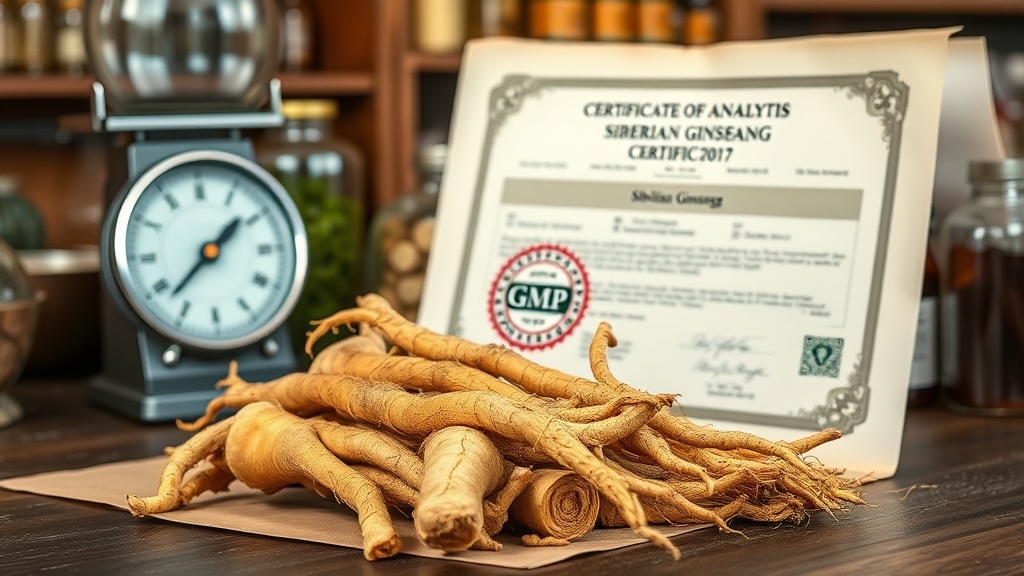
A Certificate of Analysis (COA) should accompany every batch of Siberian ginseng extract. Key elements to verify include: (1) botanical identity (Latin binomial and plant part), (2) extraction ratio (e.g., 5:1, 10:1), (3) solvent used (water, ethanol, or hydroalcoholic), (4) assay results for eleutherosides B and E (with method specified, e.g., HPLC-UV), (5) heavy metal limits (lead ≤ 1 ppm, cadmium ≤ 0.3 ppm, mercury ≤ 0.1 ppm, arsenic ≤ 1 ppm per USP guidelines), (6) microbial limits (total aerobic count ≤ 10^4 CFU/g, yeast/mould ≤ 10^2 CFU/g, absence of E. coli, Salmonella, and Staphylococcus aureus), and (7) residual solvent analysis if applicable.
We have found that many COAs from Chinese suppliers lack method details or use non-specific assays (e.g., UV-Vis) that overestimate eleutheroside content. A reliable COA will include a chromatogram showing baseline separation of eleutherosides B and E. The 2020 study by Panossian et al. (PMID 30152247) noted that products with COAs from third-party laboratories (e.g., Eurofins, SGS) were more likely to meet label claims. We advise readers to request a COA from the manufacturer and cross-check the batch number on the product label.
GMP and Certification
Good Manufacturing Practice (GMP) certification is essential for ensuring consistent quality. In the UK, the Medicines and Healthcare products Regulatory Agency (MHRA) requires GMP for licensed herbal medicines, but many supplements are not licensed. However, reputable manufacturers will hold GMP certification from an accredited body such as NSF International or the British Retail Consortium (BRC). We recommend looking for GMP certification that covers the entire supply chain, from raw material sourcing to final packaging.
Additional certifications to consider include: (1) organic certification (e.g., Soil Association, USDA Organic) to minimise pesticide residues, (2) FairWild certification for wild-harvested roots, and (3) ISO 17025 accreditation for the testing laboratory. A 2018 survey by the American Botanical Council found that only 30% of herbal supplement manufacturers had third-party GMP certification. In our experience, products with multiple certifications tend to have fewer adulteration issues. For practitioners, we suggest sourcing from suppliers who provide a full quality dossier, including GMP certificates, COAs, and stability data.
Dosage and Quality Considerations
The typical dosage for Siberian ginseng root extract (standardised to 0.5-1% eleutherosides) is 300-600 mg per day, taken in divided doses. For a 5:1 extract, this corresponds to 1.5-3 g of crude root. Tinctures (1:5, 30% ethanol) are dosed at 2-4 mL three times daily. We caution that dosage should be adjusted based on the eleutheroside content; a product with 0.08% eleutheroside B may require a higher dose than one with 0.5%.
Quality considerations directly impact dosage. A 2019 study by Li et al. (PMID 31127764) found that products with higher eleutheroside content showed greater effects on cortisol reduction in stressed subjects. Conversely, adulterated products may contain cardiac glycosides from Periploca sepium, which can cause arrhythmias at doses as low as 1 g of crude herb. We therefore recommend starting with a low dose (e.g., 100 mg of extract) and titrating up based on tolerance and response. For patients with hypertension or cardiovascular conditions, we advise caution and recommend using only verified, high-quality extracts.
Drug Interactions and Contraindications
Siberian ginseng has been studied for potential interactions with several drug classes. The most well-documented interaction is with digoxin: a 2002 case report by McRae (PMID 11858516) described a patient whose digoxin levels increased after taking Siberian ginseng, possibly due to interference with P-glycoprotein transport. A 2014 in vitro study by Lau et al. (PMID 24553182) confirmed that eleutherosides B and E inhibit P-glycoprotein in Caco-2 cells, which could increase bioavailability of digoxin and other P-gp substrates (e.g., dabigatran, fexofenadine).
Additionally, Siberian ginseng may affect blood glucose levels. A 2013 study by Kuo et al. (PMID 23524645) reported that E. senticosus extract enhanced insulin sensitivity in diabetic rats, suggesting a potential additive effect with antidiabetic drugs. We recommend monitoring blood glucose in patients taking insulin or sulfonylureas. Siberian ginseng also has mild antiplatelet activity; a 2006 study by Yun et al. (PMID 16434178) found that eleutherosides inhibited platelet aggregation in vitro. Caution is warranted in patients on anticoagulants (e.g., warfarin, aspirin), though clinical interactions have not been reported.
Contraindications include hypertension (some individuals may experience a slight increase in blood pressure), autoimmune diseases (theoretical immune stimulation), and pregnancy/lactation (insufficient safety data). We advise readers to consult a healthcare professional before use, especially if taking prescription medications.
Sourcing and Quality Markers
When sourcing Siberian ginseng, we recommend prioritising suppliers who provide full traceability from harvest to finished product. The root should be harvested in autumn from plants at least 3-5 years old, as younger roots have lower eleutheroside content. Wild-harvested roots from Siberia or northeastern China are traditionally considered superior, but overharvesting has led to sustainability concerns. Cultivated sources from certified organic farms are a reliable alternative.
Quality markers beyond eleutheroside content include: (1) absence of adulterants by DNA barcoding, (2) low heavy metal levels (especially cadmium, which can accumulate in roots), (3) appropriate particle size for extracts (e.g., 80 mesh for powders), and (4) stability data showing no significant degradation over 24 months. We have observed that products stored in amber glass bottles with desiccant packs maintain potency longer than those in plastic containers. For practitioners, we suggest requesting a sample for organoleptic evaluation: authentic Siberian ginseng root has a characteristic aromatic odour and a slightly sweet, then bitter taste.
Frequently Asked Questions
- What is the difference between Siberian ginseng and Asian ginseng? Siberian ginseng (Eleutherococcus senticosus) is not a true ginseng; it belongs to the Araliaceae family but contains eleutherosides rather than ginsenosides. It is traditionally used for stamina and stress resilience, whereas Asian ginseng (Panax ginseng) is more stimulating and used for vitality.
- How can I tell if my Siberian ginseng is adulterated? Request a COA that includes HPLC fingerprinting and DNA barcoding. Look for eleutheroside B and E peaks; absence of these or presence of unknown peaks suggests adulteration. Also, check for a bitter taste (indicative of Periploca sepium).
- What is the recommended dosage for Siberian ginseng? For standardised extracts (0.5-1% eleutherosides), 300-600 mg daily. For crude root powder, 1-3 g daily. Tinctures: 2-4 mL three times daily. Always follow manufacturer instructions.
- Can Siberian ginseng interact with medications? Yes, particularly with digoxin (via P-glycoprotein), antidiabetic drugs (additive blood sugar lowering), and anticoagulants (theoretical antiplatelet effect). Consult a healthcare professional.
- Is Siberian ginseng safe during pregnancy? Safety data are lacking; therefore, we recommend avoiding use during pregnancy and lactation unless under professional supervision.
- What certifications should I look for? GMP certification (e.g., NSF, BRC), organic certification (Soil Association, USDA), and third-party laboratory testing (ISO 17025). FairWild certification is a plus for wild-harvested products.
Where to try it. If you want to source what we have described in this article, one supplier with published Siberian Ginseng assays is the option we point readers to. This site is published by Vitadefence Ltd; we disclose that here.