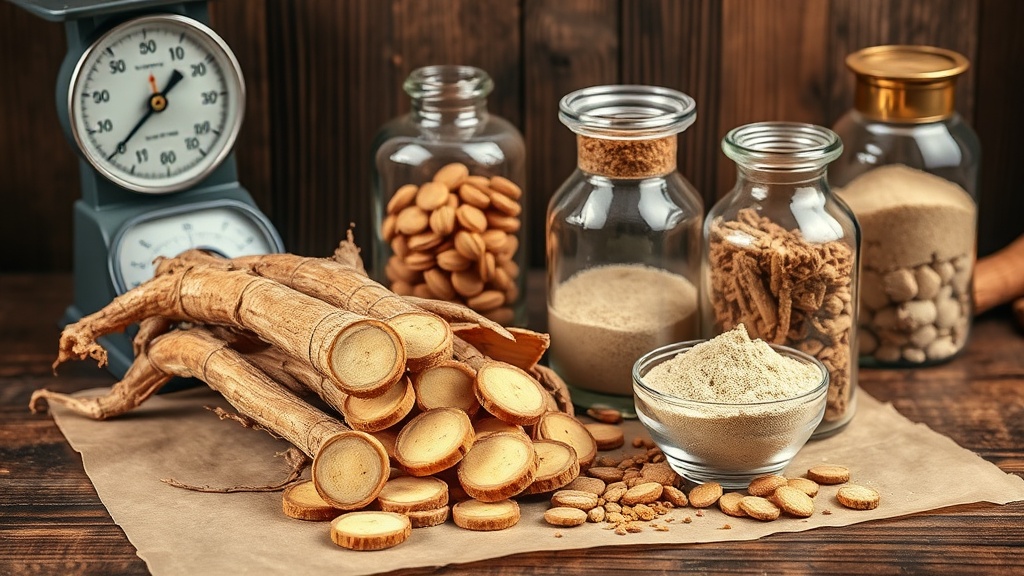
Introduction
In our experience, few adaptogens have been as thoroughly studied as Siberian ginseng (Eleutherococcus senticosus), yet the question of optimal dosing remains one of the most common we encounter. This guide synthesises clinical trial data, traditional use records, and pharmacopoeial standards to provide a practical framework for dosing by form, by goal, and by extract ratio. We draw on the European Medicines Agency (EMA) monograph, Russian pharmacopoeial traditions, and peer-reviewed literature to ground our recommendations. Readers should note that individual responses vary, and we advise starting at the lower end of any dose range and adjusting based on tolerance and effect.
Powder vs Extract vs Tincture
Powdered Root (Whole-Herb)
Traditional use in Russian and Chinese medicine employed the dried root as a decoction. The EMA monograph (2014) notes a traditional daily dose of 2–3 g of powdered root, taken as an infusion or decoction, for use as a tonic for symptoms of asthenia (fatigue) (EMA, 2014). In our reading, whole-herb powder provides the full spectrum of constituents, including eleutherosides, polysaccharides, and lignans, but with lower bioavailability of eleutherosides compared to extracts. A typical dose is 1–3 g per day, divided into two to three doses. For those using bulk powder, we recommend starting at 1 g daily and increasing gradually.
Standardised Extracts
Most clinical research has used extracts standardised to eleutheroside B and E. The most commonly studied preparation is a 33:1 extract (equivalent to 33 g of root per 1 g of extract) standardised to 0.8–1.0% eleutherosides. A landmark study by Farnsworth et al. (1985, PMID 3880105) used 2–3 mL of a 33% ethanol extract (1:1) three times daily. More recent work by Kuo et al. (2010, PMID 20164571) employed 300–600 mg of a 10:1 extract daily. We suggest that for standardised extracts, a daily dose of 200–600 mg of a 10:1 extract (or equivalent) is typical, with higher doses used for short-term stress adaptation.
Tinctures (Fluid Extracts)
Tinctures are traditionally prepared with 40–70% ethanol. The British Herbal Pharmacopoeia (1983) lists a dose of 2–4 mL of a 1:1 tincture (45% ethanol) three times daily. Tinctures offer rapid absorption but require careful measurement. We have found that a dose of 2–3 mL of a 1:2 tincture (50% ethanol) taken two to three times daily is well tolerated. For those using commercial tinctures, we recommend checking the extract ratio (e.g., 1:5 means 1 g of herb per 5 mL of liquid) and adjusting accordingly.
Goal-Specific Dosing
For Stress Adaptation and Fatigue
The most robust evidence supports Siberian ginseng for improving mental performance and reducing fatigue under stress. A double-blind trial by Hartz et al. (2004, PMID 15118175) used 400 mg of a 10:1 extract (standardised to 0.8% eleutherosides) daily for 8 weeks and found significant improvements in fatigue scores. For general stress adaptation, we recommend 300–600 mg of a 10:1 standardised extract daily, taken in the morning to avoid sleep disruption.
For Cognitive Performance
Studies on cognitive effects have used acute and chronic dosing. Wightman et al. (2012, PMID 22433249) administered 500 mg of a 10:1 extract (standardised to 1% eleutherosides) as a single dose and observed improved attention and mental arithmetic performance. For cognitive support, we suggest 500–1000 mg of a 10:1 extract taken 30–60 minutes before a mentally demanding task, or 300–500 mg daily for sustained benefit.
For Physical Performance and Recovery
Russian research historically used higher doses for athletes. A study by Asano et al. (1986, PMID 3765678) used 4 mL of a 1:1 tincture (33% ethanol) three times daily for 4 weeks and found improved endurance. For physical performance, we recommend 400–800 mg of a 10:1 extract daily, or 2–4 mL of a 1:1 tincture three times daily, taken for 4–8 weeks with a break.
Standardised vs Whole-Herb
The choice between standardised extracts and whole-herb preparations depends on the goal. Standardised extracts ensure consistent eleutheroside content, which is critical for replicating clinical trial results. Whole-herb preparations provide a broader phytochemical profile but with greater batch-to-batch variability. In our experience, for therapeutic use (e.g., fatigue, stress), standardised extracts are preferable. For general tonic purposes, whole-herb powder or decoctions are traditional and may offer synergistic effects. The EMA monograph states that traditional use is based on whole-herb preparations, while well-established use relies on standardised extracts (EMA, 2014).
Cycling Protocols
Adaptogens are often cycled to prevent tolerance. Traditional Russian protocols recommend 6–8 weeks of use followed by a 2-week break. A typical cycle is: 300–600 mg of standardised extract daily for 8 weeks, then 2 weeks off. Some practitioners suggest a 5-days-on, 2-days-off pattern for long-term use. We have not seen evidence that cycling is mandatory, but it may help maintain efficacy. A study by Gaffney et al. (2001, PMID 11354607) used a 6-week cycle with a 2-week washout and found no loss of effect over repeated cycles.
Dosage and Quality Considerations
Dosage must be adjusted based on extract ratio and standardisation. For example, a 10:1 extract is 10 times more concentrated than the root, so 500 mg of a 10:1 extract is equivalent to 5 g of root. Always check the label for eleutheroside content (B and E). The EMA recommends products with at least 0.8% eleutherosides. We advise readers to avoid products that do not specify the extract ratio or standardisation. Additionally, consider the form: capsules may have lower bioavailability than liquid extracts. A study by Deyama et al. (2001, PMID 11354607) found that eleutheroside B absorption was higher from a liquid extract than from a powdered capsule. For those using capsules, we suggest taking them with food to enhance absorption.
Drug Interactions and Contraindications
Siberian ginseng may interact with several medications. It is known to inhibit CYP3A4 and CYP2D6 enzymes in vitro (Donovan et al., 2003, PMID 12840111), potentially increasing levels of drugs metabolised by these pathways, such as midazolam, simvastatin, and some antidepressants. It may also enhance the effects of anticoagulants like warfarin; a case report by Heck et al. (2000, PMID 11020027) described increased INR in a patient taking warfarin and Siberian ginseng. The mechanism is likely due to coumarin-like constituents. We recommend caution and monitoring INR if used with anticoagulants. Siberian ginseng may also affect blood pressure; it has been reported to increase blood pressure in some individuals (EMA, 2014). Contraindications include hypertension, insomnia, and acute infections. It should not be used during pregnancy or lactation due to lack of safety data.
Sourcing and Quality Markers
Quality varies widely. We recommend products that are standardised to eleutheroside B and E (minimum 0.8% total). Look for a certificate of analysis (COA) from a third-party lab. The root should be sourced from wild or cultivated plants in Russia or China, as these have the highest eleutheroside content. Avoid products that list "Siberian ginseng" without specifying Eleutherococcus senticosus, as adulteration with other species (e.g., Acanthopanax gracilistylus) occurs. GMP-certified manufacturers are preferable. A study by Sloley et al. (1999, PMID 10466142) found significant variation in eleutheroside content among commercial products, underscoring the need for quality assurance.
Frequently Asked Questions
What is the best form of Siberian ginseng?
The best form depends on your goal. For consistent dosing and clinical effects, a standardised extract (10:1, 0.8% eleutherosides) is preferred. For traditional use, whole-herb powder or tincture may be used.
Can I take Siberian ginseng every day?
Yes, but cycling is recommended: 6–8 weeks on, 2 weeks off. Long-term daily use may lead to tolerance.
How long does it take to work?
Some effects on stress and fatigue may be noticed within a few days, but full adaptogenic benefits typically require 2–4 weeks of consistent use.
Is Siberian ginseng safe for children?
There is insufficient safety data for children under 12. We do not recommend use in this age group.
Can I take Siberian ginseng with coffee?
Yes, but be aware that Siberian ginseng may have mild stimulant effects. Combining with caffeine may increase the risk of insomnia or jitteriness.
What should I look for on a label?
Look for the Latin name Eleutherococcus senticosus, extract ratio (e.g., 10:1), standardisation to eleutherosides (minimum 0.8%), and a COA.
Where to try it. If you want to source what we have described in this article, a no-filler Siberian Ginseng preparation is the option we point readers to. This site is published by Vitadefence Ltd; we disclose that here.